
- Published at
Loss Leader Logic: The Data Journalist’s Guide to the 2026 Flyer
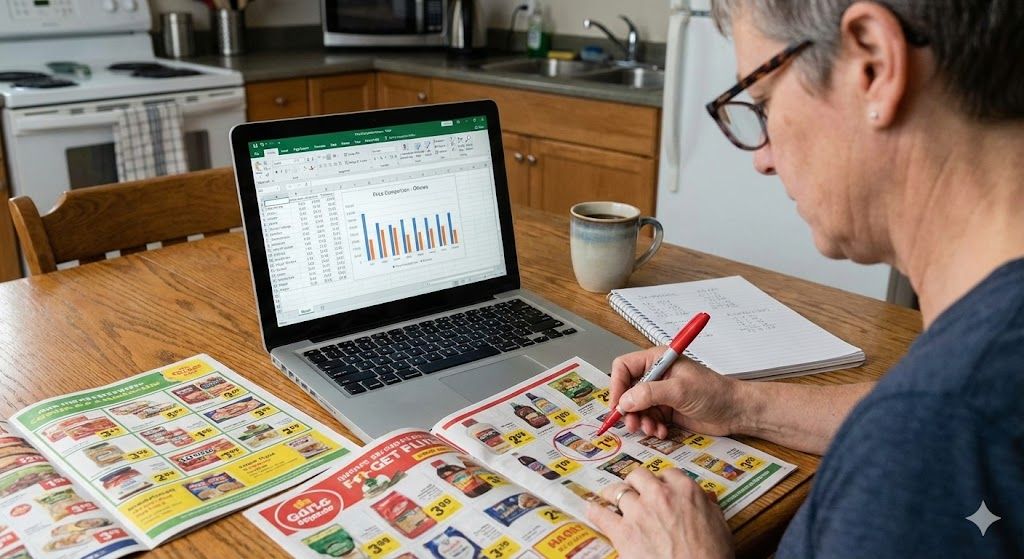
Most people shop for cravings; the rich shop for data. Learn how to identify 'Loss Leaders' in Ottawa flyers and build a high-ROI, Flyer-First pantry.
Loss Leader Logic: The Data Journalist’s Guide to the 2026 Flyer
Key Takeaways:
- The “Data Journalist” Mindset: Shifting from emotional shopping to objective asset acquisition.
- Identifying the “Losers”: How to spot the 3-4 items stores price below cost to lure you in.
- The Floor Price Principle: Understanding the absolute minimum price for staples in the Ottawa market.
- Automated Investigation: Using MealestroAI to perform the weekly “Data Audit” of local Loblaws and Metro promotions.
The Amateur’s Mistake
Every Wednesday night in Ottawa, thousands of people open their grocery apps or physical flyers with the same question: “What do I feel like eating next week?” They scan the pages looking for inspiration. They see a recipe for steak, notice it’s “on sale” for $14.99/lb, and add it to their list. They feel like they’ve won because they found a discount.
But they didn’t win. They fell for the trap.
In the 2026 economy, with the average family of four expected to spend over $17,500 on food annually, shopping for “what you like” is a financial death sentence. To survive, you have to stop being a consumer and start being a Data Journalist. A journalist doesn’t care about what looks tasty; they care about the “Lead” - the one piece of information that the store is trying to hide or use as bait.
Part 1: The Anatomy of a “Loss Leader”
Grocery stores are not in the business of giving you deals; they are in the business of Foot Traffic. To get you through the door of a Loblaws or a Metro, they use a tactic called the Loss Leader.
A Loss Leader is a product sold at or below the store’s cost. The store expects to lose $2.00 every time you buy that block of butter, because they know the average shopper will also buy $100 of high-margin items like spices, cereal, or snacks while they are there.
How to Spot a True Loss Leader in 2026:
- The “Front Page” Anchor: If it’s in the biggest font on the front page of the flyer, it’s likely a candidate.
- The “Known Value” Item: Loss leaders are almost always items where you know the price (Milk, Eggs, Butter, Ground Beef, Chicken Breast). You wouldn’t know if a jar of specialty olives is a “deal,” but you know when butter hits $4.99.
- The Quantity Limit: If the flyer says “Limit 2 per customer,” you’ve found the lead. The store is literally trying to stop you from taking too much of their money.
Part 2: The “Floor Price” and the Flyer-First Pantry
A Data Journalist knows the Floor Price — the absolute historical low for an item in their region.
In Ottawa, for example:
- Butter: Anything under $5.00 is a Floor Price.
- Chicken Breast: Anything under $4.50/lb is a Floor Price.
- Pasta: Anything under $1.00/bag is a Floor Price.
The Strategy: You do not buy staples when you “need” them. You buy them when they hit the Floor Price. This creates a Flyer-First Pantry.
When butter hits $4.99 at the Metro on Carling, a consumer buys one block. A Data Journalist buys the limit, puts two in the freezer, and builds their entire week of baking and cooking around that asset. You are no longer paying market rates; you are “investing” in your own inventory at the lowest possible cost.
Part 3: The Psychology of “Impulse Neutralization”
Why don’t more people do this? Because it’s mentally taxing. Retailers spend millions on “Store Psychology” — placing the milk (a loss leader) at the very back of the store so you have to walk past 5,000 high-margin items to get it.
The Data Journalist uses Impulse Neutralization:
- The Tactic: Your list is not a suggestion; it is a legal contract. If it isn’t a Loss Leader or a pre-planned “Anchor Protein,” it does not enter the cart.
- The Advice: Shop with headphones on. Listen to a podcast. Block out the sensory marketing of the “fresh bread smell” and the bright “New Product” endcaps. You are there for the data, not the experience.
Part 4: How MealestroAI Automates the Investigation
The biggest barrier to this lifestyle is time. It takes 40 minutes to cross-reference four Ottawa flyers to find the 3-4 true Loss Leaders. Most parents simply don’t have that time.
I built MealestroAI to act as your Digital Data Journalist.
- Automated Loss Leader Detection: Every week, I manually input the deep-discount promotions for Loblaws and Metro. The system doesn’t just show you “sales”; it identifies the Anchor Proteins that represent the best ROI for your plan.
- Reverse-Engineered Menu: Instead of you looking for a recipe and then checking the price, MealestroAI starts with the Floor Price data and suggests meals that use those specific assets. It does the “Flyer-First” thinking for you.
- Zero-Time Investment: You don’t have to scan flyers. You simply select the store where you do your groceries and the plan for next week is automatically generated using the products on the promotion in your store.
The Result: Flipping the Script
The grocery store wants you to be an emotional shopper. They want you to be “inspired” by their aisles. When you adopt the Loss Leader Logic, you flip the script. You stop being the person whose budget is “drained” by the store, and you start being the person who only shows up to take the deals and leave.
By using MealestroAI to automate this investigation, you save the 30% on your bill without the “Sunday Tax” of manual research. You aren’t just eating better; you’re winning the data war.
Stop being a consumer. Become a Data Journalist and automate your savings with MealestroAI.