
- Published at
The $15-Per-Plate Lie: Why Meal Kits Are Not the Answer to 2026 Inflation
Are meal kits actually saving you money? Learn the brutal truth about the 300% markup on meal kits and why they fail to solve the root cause of high grocery bills.
The $15-Per-Plate Lie: Why Meal Kits Are Not the Answer to 2026 Inflation
Key Takeaways:
- The Convenience Premium: Understanding the 3x markup you pay for “outsourced logistics.”
- The Parallel System Trap: Why meal kits ignore your existing pantry assets and create more waste.
- The Eco-Guilt Factor: The hidden environmental cost of “portion-controlled” packaging.
- Flyer-First ROI: How MealestroAI provides the same “autopilot” convenience at a fraction of the cost.
The Cardboard Graveyard
Three years ago, I thought I had found the holy grail of adulting. Every Tuesday, a heavy box would arrive on my porch in Ottawa. Inside were three perfectly portioned meals, complete with tiny plastic tubs of sour cream and single-clove garlic packets. For a few weeks, I felt like I had beaten the system. No more “What’s for dinner?” panic. No more grocery store lines.
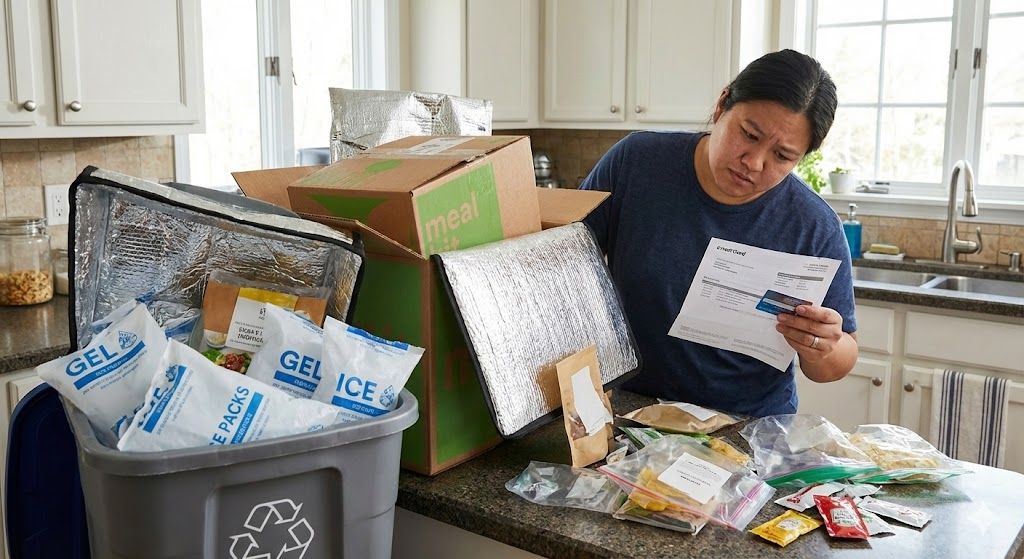
But then, reality hit. It started with the “Cardboard Graveyard” in my garage - a stack of insulated boxes and silver liners that I couldn’t recycle and felt too guilty to throw away. Then came the “Parallel Fridge Crisis.” I had a box of meal kit ingredients sitting on the top shelf, while the ground beef and spinach I had bought at Metro “just in case” were rotting in the bottom drawer.
I was paying $160 a week for four nights of dinner for my family. That’s $640 a month. And I still had to go to the grocery store for milk, eggs, and the other three nights of the week.
I wasn’t saving time or money; I was paying a 300% markup to outsource my decision-making. In the 2026 economy, that isn’t a “convenience” - it’s a financial bleed.
Part 1: The Brutal ROI of “Outsourced Logistics”
Meal kits like HelloFresh, Chef’s Plate, and GoodFood sell you a dream of “stress-free cooking.” But in 2026, with the average Canadian family’s grocery bill hitting $17,500 annually, the math on these kits has become impossible to justify for the middle class. Watch this analysis on YouTube.
The average meal kit in Canada currently cost somewhere between $12 and $15 per serving. For a family of four, one single dinner costs $60.
- The Grocery Reality: That same meal - let’s say chicken tacos with a side slaw - costs approximately $4.50 per serving when built using “Flyer-First” Anchor Proteins (loss leaders).
- The Markup: You are paying nearly $40 per meal for the “service” of having someone else eliminate your Sunday planning labor.
If you use a meal kit three times a week, you are spending roughly $6,240 more per year than a family that uses a systematized grocery plan. That is more than six times the projected 2026 inflation spike. You aren’t fighting inflation; you are inviting it into your kitchen and giving it a seat at the table.
Part 2: The “Parallel System” Trap
The most significant failure of the meal kit model isn’t just the price; it’s that it operates as a Parallel System to your actual life.
Inventory Ignorance
Meal kits do not know you have a half-used bag of rice in the pantry. They do not know you have a freezer full of chicken breasts you bought on sale last week. They send you more rice and more chicken at full price. This results in Inventory Bloat, where your pantry becomes a graveyard of half-used items while you continue to pay for new ones.
The “All or Nothing” Failure
Meal kits are binary. If you have a late meeting and can’t cook the “15-minute” salmon on Wednesday, that salmon sits in its bag. Because it’s a specific “kit,” you are less likely to repurpose those ingredients into something else. The result? The “Buy-Rot-Throw” cycle happens anyway, only this time, you paid a premium for the food that’s rotting.
Part 3: The Psychology of “Guilt Management”
Why are meal kits so popular if the math is so bad? Because they solve Decision Fatigue, not the grocery bill.
For a busy parent at 5:00 PM, the mental labor of “figuring it out” is the most painful part of the day. Meal kits provide a temporary relief from that pain. They are essentially a Guilt-Management Service. You feel “good” because you cooked a meal from scratch, ignoring the fact that you paid $60 for $15 worth of food and created a trash bag full of plastic waste.
The 2026 Shift: In a lower-inflation world, we could afford to pay for guilt management. In 2026, we need System Management. We need a way to get the “autopilot” feeling of a meal kit without the “luxury” price tag.
Part 4: Tactical Solutions: Transitioning to Flyer-First Logistics
You can have the convenience of a meal kit without the $6,000 annual “Tax.” Here is how to build your own “In-House” meal kit system:
1. The “Kit-ify” Prep Session
The real secret of meal kits is that the ingredients are grouped.
- The Tactic: When you get home from your “Flyer-First” grocery run, group your ingredients by meal in clear bins.
- The Result: When you open the fridge on a Tuesday, you see a “Chicken Taco Bin.” The decision is already made. You’ve created the “Meal Kit” experience for $4.50/serving.
2. The Anchor Protein Rule
Meal kits limit your choices to 20-30 recipes. You should limit yours to what is on sale.
- The Tactic: Pick two proteins that are on deep discount in the local Ottawa flyers. Build three meals around those. This mimics the “Limited Choice” psychology that makes meal kits feel easy, but it keeps the savings in your pocket.
3. Use a Digital Logistics Layer
The only thing a meal kit provides that a grocery store doesn’t is the Plan.
- The Tactic: Use an automated system to handle the “Flyer-to-Recipe” matching. This removes the mental labor (The Sunday Tax) without the physical waste of a delivery box.
Part 5: How MealestroAI Replaces the Meal Kit
I built MealestroAI specifically for people who are “recovering” from the meal kit trap. We wanted to provide the Autopilot Experience for a fraction of the cost.
- Local Pricing over Fixed Pricing: While meal kits charge you a flat (high) fee, MealestroAI builds your plan around local Ottawa promotions (Loblaws, Metro, etc.). It finds the “Loss Leaders” for you, so your cost per plate stays low.
- Inventory Integration: Unlike HelloFresh, MealestroAI knows what you have. Our proactive check-in feature forces you to audit your fridge assets first. The system then builds a plan that uses what you already own, effectively “shopping your own kitchen” before spending more money.
- No Cardboard Graveyard: There is no packaging waste. You buy exactly the quantities you need from your local store (using our Precision Quantity Logic), supporting your local economy and keeping your bin empty.
- The $5,000 Raise: By switching from a meal kit to a MealestroAI Flyer-First system, the average family “saves” enough to effectively give themselves a $5,000 annual raise.
The Result: Real Convenience
Convenience shouldn’t cost you a family vacation. When you move from “buying kits” to “managing a system,” you get the calm, controlled kitchen you were promised, without the $15-per-plate lie.
Stop paying the convenience tax. Start your automated Flyer-First plan with MealestroAI.