
- Published at
The Geometry of Groceries: Why Store-Hopping is Burning Your Hourly Wage
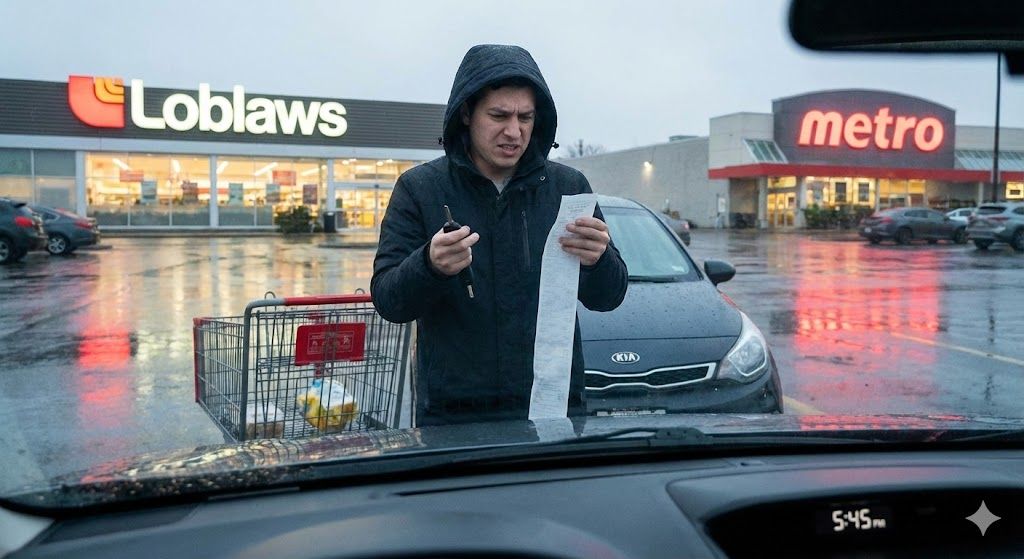
Stop chasing every sale. Discover why store-hopping kills your budget and how to optimize your favorite store using a 'Logistics Hub' strategy to save time and money.
The Geometry of Groceries: Why Store-Hopping is Burning Your Hourly Wage
Key Takeaways:
- The “Penny Wise, Pound Foolish” Trap: Why driving 15 minutes to save $4 on butter is a net financial loss.
- The Logistics Hub Strategy: How picking a single primary store reduces cognitive load and maximizes efficiency.
- The True Cost of a Trip: Calculating fuel, vehicle depreciation, and the “Parental Hourly Wage” in your grocery budget.
- Optimized Loyalty: Using MealestroAI to squeeze every possible “Loss Leader” out of your favorite store without leaving the parking lot.
The $7 Butter Quest
It was a rainy Thursday in Kanata. I was sitting at my kitchen table, looking at a flyer for a grocery store in Orléans - nearly 35 kilometers away. They had butter on sale for $4.99, while my local Loblaws was charging $8.99. My “Inner Hunter” screamed that this was a win. I grabbed my keys, fought the Queensway traffic for 40 minutes, snagged my limit of three blocks of butter, and drove home feeling like a financial genius.
When I got back, I sat down and did the “Brutal Math.”
- Gas: ~7 liters of fuel round-trip (at $1.60/L) = $11.20.
- Time: 80 minutes of my life.
- Total “Savings”: $12.00.
I had spent $11.20 in fuel and nearly an hour and a half of my life to “save” 80 cents. If I were an employee, I would have just worked for a wage of $0.60 per hour.
I realized then that I was a victim of a “Logistics Failure.” I was treating my grocery shopping like a scavenger hunt rather than what it actually is: a high-frequency logistics operation. In the 2026 economy, “Store-Hopping” is a luxury that busy parents literally cannot afford.
Part 1: The Hidden Math of the “Scavenger Hunt”
Most people believe that “finding the best price” is the ultimate goal of meal planning. This is a fallacy. The goal is to lower your Total Cost of Procurement, which includes fixing your logistics system first. This includes the price of the food, the cost of the transit, and the value of your time.
1. The Fuel and Wear Factor
According to the CAA, the average cost to operate a vehicle in Canada is roughly $0.22 to $0.30 per kilometer when you factor in fuel, maintenance, and depreciation. A “quick trip” to a second store 5km away actually costs you $3.00 before you even walk through the sliding doors. If you aren’t saving at least $10 at that second location, you are likely breaking even at best.
2. The “Parental Wage”
Your time is not free. If you are a parent with a career, your “off-hours” are your most valuable asset. If you value your time at a modest $40/hour, every 15 minutes spent driving between stores adds a $10 “Time Tax” to your grocery bill.
The Geometry Trap: When you visit three stores to catch three different sales, you aren’t “beating inflation” - you are paying a massive “Complexity Tax” that leaves you exhausted and financially stagnant.
Part 2: The Psychology of the “Loss Leader” Trap
Grocery stores in Ottawa, from the Superstore on Richmond Road to the Metro in the Glebe, use a psychological tactic called the Loss Leader. They price one or two high-visibility items (like milk, eggs, or butter) below cost to lure you in.
The “Trap” isn’t the sale; it’s the Impulse Inevitability. Once you are in that second or third store to get the “deal,” your brain rewards you for being “frugal.” This dopamine hit lowers your inhibitions. You think, “Well, I’m already here, I might as well grab some cereal and these cookies.” Because you don’t know the “Floor Prices” of the other items in that store, you end up buying non-sale items at a premium. The store makes its money back on your lack of focus, and your “savings” disappear into a bag of full-priced chips.
Part 3: Tactical Solution: The “Logistics Hub” Strategy
To survive 2026 grocery inflation, you must stop being a “Hunter” and start being a “Logistics Manager.” This requires the Logistics Hub Strategy.
1. Define Your “Logistics Hub” (The Primary Store)
Pick one store that serves as your base of operations. This should be the store that is geographically closest to your commute or home, and whose layout you know like the back of your hand.
- The Tactic: Stop checking every flyer for every store. Commit to your Hub. Learn where the “Manager’s Specials” rack is. Know which day they restock the produce.
2. The “High-ROI” Exception Rule
You are only allowed to leave your Logistics Hub for a “Secondary Store” if the mathematical ROI is undeniable.
- The Rule: The savings at the second store must be 3x the cost of the transit.
- The Example: If the second store is 4km away ($2.40 round trip), you must be saving at least $7.20 on a single “Staple Asset” (like a bulk pack of meat or 5kg of rice) to justify the trip. If you can’t hit that number, you buy it at your Hub and move on with your life.
3. Mastering the “Hub Layout”
Familiarity is a time-saver. When you shop the same store every week, your “Pathing” becomes efficient. You avoid the “Browsing Aisles” where impulse buys live.
- The Tactic: Shop the perimeter first. Only enter the middle aisles for specific “Pantry Staples” that you’ve already audited from your fridge.
Part 4: How MealestroAI Optimizes Your Logistics Hub
I built MealestroAI because I realized that the “Sunday Tax” was largely spent trying to reconcile different store prices. I wanted a tool that would allow me to pick my favorite store and simply squeeze the best results out of it.
When you use MealestroAI, you are no longer a “Store-Hopper”:
- Store Preference Locking: You don’t get a random list of deals from across the city. You select your preferred local store (e.g., the Metro Cumberland). The AI then builds your entire 7-day plan using only the promotions available at that specific location.
- “Flyer-to-Pantry” Maximization: Instead of chasing a deal at a different store, MealestroAI identifies the “Loss Leaders” within your Hub. It builds your menu around what your chosen store is losing money on that week, ensuring you get the 30% savings without the 40-minute drive.
- No More Fragmented Lists: Because the plan is store-specific, your shopping list is organized by the actual categories of your Hub. You walk in, follow the path, and walk out. You’ve successfully “hacked” the store’s pricing model without leaving your neighborhood.
- The “Gas Savings” ROI: By eliminating the need for a second or third stop, MealestroAI pays for itself in gas savings alone within the first two weeks of use.
The Result: Reclaiming Your Time
The “Geometry of Groceries” is simple: the shortest distance between your budget and your sanity is a single, optimized trip. When you commit to a Logistics Hub and use a tool like MealestroAI to handle the promotion-matching, you stop burning your hourly wage in traffic. You get the deals, you keep your weekend, and you finally stop the “Scavenger Hunt” for good.
Stop the store-hopping. Choose your favorite store and let MealestroAI optimize your plan now.