
- Published at
Your Grocery Bill Is High Because Your Plan Is Missing
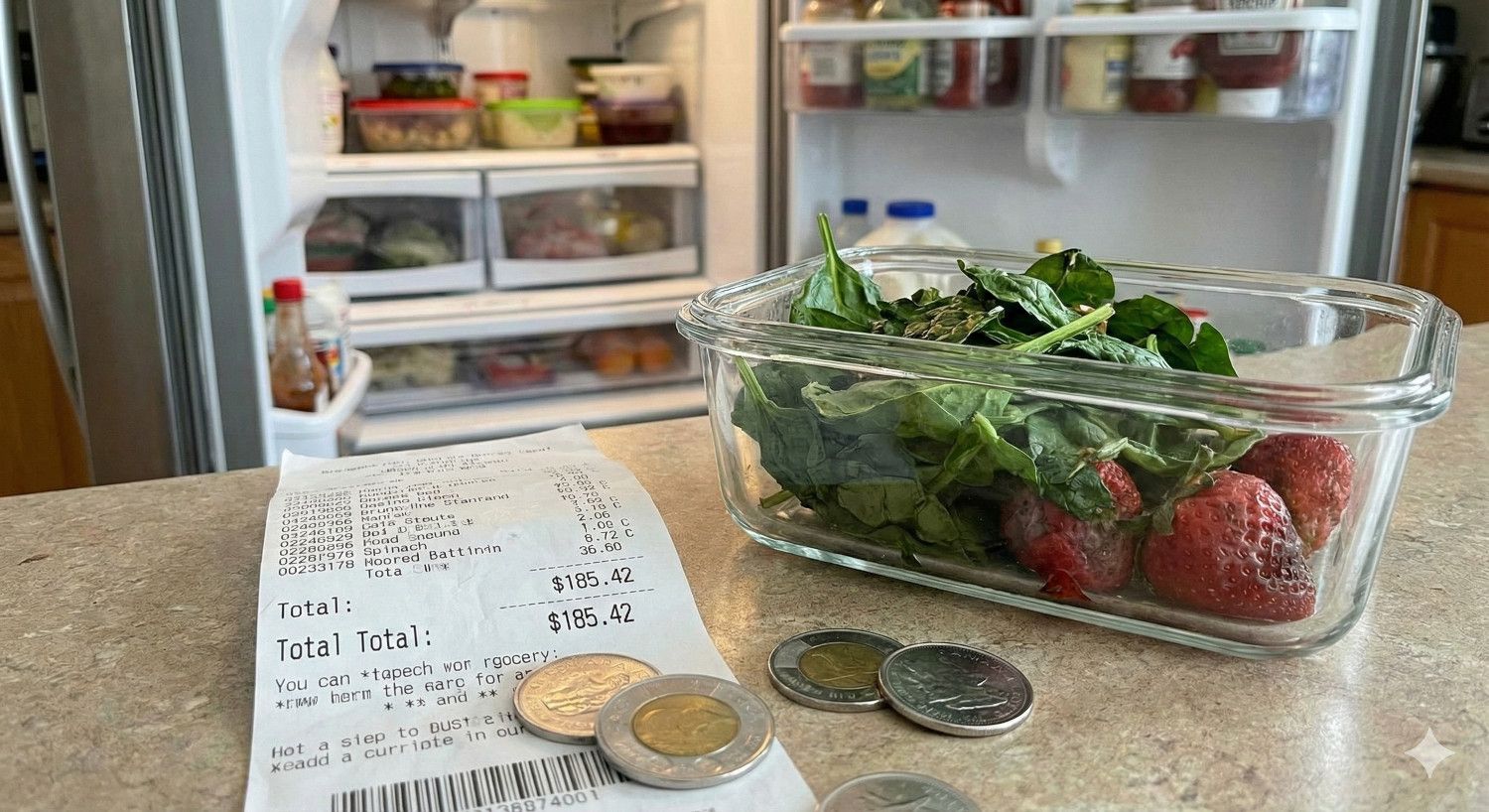
Canadian families face a $1,000 grocery inflation spike in 2026. Learn how to stop the financial bleed by fixing your kitchen logistics and planning gap.
Your Grocery Bill Is High Because Your Plan Is Missing
Key Takeaways:
- The $1,000 Inflation Spike: Why 2026 is a breaking point for Canadian family food budgets.
- The Logistics Gap: Why “buying cheaper” fails if you don’t fix how you cook.
- Flyer-First Strategy: The tactical shift from recipe-hunting to promotion-driven planning.
- Automation as the Exit: How to use MealestroAI to remove the mental load of saving money.
The Thursday Night Revelation
It was 6:15 PM on a rainy Thursday in Ottawa, and I was staring into a refrigerator that was technically “full,” yet I was ten minutes away from spending $75 on a middle-of-the-road takeout order.
My wife had shopped on Sunday with the best of intentions. There was a bag of organic kale that was already beginning to turn into a dark green liquid at the bottom of the crisper drawer. There was a half-used jar of pesto from three weeks ago growing a fuzzy white ecosystem. There was a package of chicken breasts that had expired yesterday because we “forgot” they were there.
In that moment, I realized the brutal truth: we weren’t struggling because food was expensive (though it was). We were struggling because we were operating a high-cost kitchen with zero logistics. We were essentially a small business that was losing 30% of its inventory to rot every single week.
This isn’t a discipline problem. It’s a system problem. And in 2026, with the prices we are seeing, a “system problem” is a luxury you can no longer afford.
Part 1: The Brutal Reality of 2026 Grocery Costs
According to the 2026 Canada Food Price Report, a family of four will spend approximately $1,000 more on groceries this year than they did last year. Total annual bills for the average household are now hovering near the $17,500 mark.
Most advice online tells you to “buy in bulk” or “clip coupons.” This is legacy advice that doesn’t work in the current economy. Bulk buying often leads to more waste because families cannot consume the quantities before they spoil. Couponing takes hours of time — a resource that busy parents have even less of than money.
The reality is that you are likely “The $1,300 Kitchen Leak.” Research shows the average household throws away over $1,300 worth of edible food annually. This isn’t just a waste of food; it is a direct financial bleed. If your boss took $100 out of your paycheck every month and threw it in a green bin, you’d quit. Yet, most of us do exactly that in our own kitchens.
Part 2: The Psychology of the “Buy-Rot-Throw” Cycle
Why do we keep buying food we don’t eat? It comes down to Aspirational Shopping and Decision Fatigue.
Decision Fatigue: The phenomenon where the quality of decisions made by an individual deteriorates after a long session of decision-making. For parents, by 5:00 PM, the brain is “done.” This is why having too many recipe choices leads to ordering takeout instead of cooking.
When you shop on Sunday, you are your “Best Self.” You buy the spinach for the smoothies you plan to make. You buy the fresh fish you plan to sear. But by Wednesday at 5:00 PM, after work and shuttling kids to hockey or gymnastics, your “Best Self” has been replaced by your “Exhausted Self.”
The Exhausted Self cannot figure out how to cook the fish. The Exhausted Self orders pizza. The fish stays in the fridge until Saturday, when it is promptly thrown away. This is the Buy-Rot-Throw Cycle. It is a cognitive trap that uses your good intentions against your bank account.
Part 3: Tactical Solutions: Reclaiming Your Budget
To fight 2026 prices, you must move from “Vibe-Based Cooking” to a “Logistics-Based Kitchen.” Here is the 3-step framework to stop the bleed:
1. The “Reverse Meal Plan” (Pantry First)
Stop looking for recipes on Pinterest and then going to the store. Instead, look at what you already have.
- The Tactic: Before you spend a dime, spend 5 minutes doing a “Pantry Audit.” Identify two items that must be used this week. Build your first two meals around those. You aren’t “going shopping”; you are “filling the gaps” of what you already own.
2. Quantity-First Cooking
We often cook too much pasta, too much rice, and too many sides “just in case.”
- The Tactic: Use a scale. If you are a family of four, cook exactly the grams of pasta required for four. This prevents the “vague bowl of leftovers” that sits in the fridge for four days before being tossed. If you don’t have a specific plan for a leftover, do not cook the extra portion.
3. Flyer-First Anchor Proteins
In Ottawa, store promotions are the only way to beat inflation.
- The Tactic: Open your local flyer and find the “Loss Leader” - the meat or protein that is on deep discount (often 30-50% off). Pick two. Those are your “Anchor Proteins” for the week. If chicken thighs are $4/lb off at Loblaws or Farm Boy, you are a chicken-thigh household this week. Period.
Part 4: How MealestroAI Automates the Solution
I built MealestroAI because I was tired of being the person throwing away a $1,300 “vacation” into the green bin every year. Manual planning is a full-time job, and you already have one.
When you use MealestroAI, the logistics of a low-waste kitchen happen automatically:
- Curated Flyer Integration: Every Thursday morning, I manually update the system with local Ottawa grocery promotions (currently Loblaws and Metro). Your meal plan is built around what is actually on sale right now, so you get the “Flyer-First” strategy without hunting through flyers yourself.
- Precision Quantity Logic: It calculates exactly how much you need to buy and cook based on your family size, so the “Buy-Rot-Throw” cycle is broken by design.
- Planned-Over Architecture: It doesn’t just give you recipes; it builds a “Bridge Plan” where Monday’s extra roasted vegetables become the base for Tuesday’s soup.
- Behavioral Accountability & Systemized Habits: This is a complete system designed to sustain home cooking habits and best practices, not just a list of recipes. MealestroAI proactively checks in to ensure you’ve verified what’s already in the fridge before the planning begins. Meal plans are delivered automatically and are super-personalized to your family’s specific needs, though a one-time version is always available.
The Result: A Calm, Controlled Kitchen
The goal isn’t just to save $1,000 this year (though you will). The goal is to eliminate the 4:00 PM panic. When the system handles the logistics, you can go back to being a parent instead of a kitchen manager.