
- Published at
The Recipe-First Trap: How Your Favorite App is Secretly Bloating Your Grocery Bill
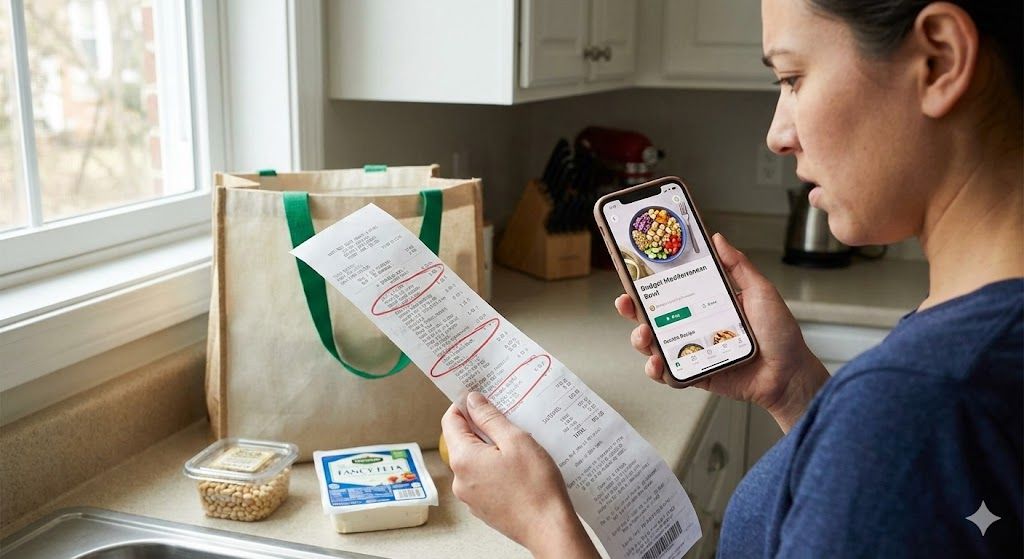
Stop overpaying for 'healthy' meals. Discover why popular recipe apps cause localized blindness and how a Flyer-First strategy saves 30% on groceries.
The Recipe-First Trap: How Your Favorite App is Secretly Bloating Your Grocery Bill
Key Takeaways:
- Localized Blindness: Why generic recipe apps are fundamentally disconnected from your local Ottawa store prices.
- The “Healthy” Tax: How following trending recipes leads to buying non-sale, high-margin ingredients.
- Flyer-First Architecture: Shifting your workflow to prioritize “Loss Leaders” before choosing a menu.
- The 30% Savings Formula: How integrating local real-time data into your planning can slash $200 off your monthly bill.
The $18 “Budget” Salad
Last month, I was scrolling through one of those high-end recipe apps - you know the ones, with the minimalist UI and the promise of “meal planning made easy.” I found a “Budget-Friendly Mediterranean Bowl” that looked perfect. It was tagged under “cheap eats.”
I added the ingredients to my digital list and headed to the Loblaws near my place in Ottawa. By the time I hit the checkout, that “cheap” salad had cost me nearly $18 in ingredients alone. The bell peppers weren’t on sale ($5.99 for a 3-pack), the specific feta they recommended was a premium brand ($9.00), and the “handful of pine nuts” cost more than the protein.
I walked out feeling like I’d been scammed. And I was. I had fallen into the Recipe-First Trap.
We’ve been conditioned to believe that the “recipe” is the starting point of a good meal. But in 2026, with Canadian grocery inflation acting like a predatory lender, starting with a recipe is a luxury most of us can no longer afford. If your meal planning app doesn’t know what is on sale at the Metro or Loblaws down the street from you right now, it isn’t a tool - it’s a catalog for overspending.
Part 1: The Brutal Economics of “Localized Blindness”
The core problem with apps is what I call Localized Blindness. These platforms are designed for “Discovery.” They want to show you what looks good so you keep using the app. They are functionally “Flyer-Blind.”
When an app suggests a recipe for “Honey Garlic Chicken,” it is making a massive assumption: that chicken is priced reasonably in your neighborhood this week.
- The Sale Gap: In Ottawa, the price of chicken breast can fluctuate by as much as 45% week-over-week depending on which store has it as a “Loss Leader”.
- The Missing ROI: If you follow a recipe app’s suggestion when chicken is not on sale, you are paying a “Convenience Tax” that adds up to roughly $50 per week for a family of four.
According to the Canada Food Price Report 2026, meat and vegetables remain the most volatile categories. Following a “Recipe-First” strategy often means you are buying according to a software developer’s algorithm in California rather than the economic reality of your local Canadian grocery aisle.
Localized Blindness: The failure of a planning tool to account for regional price volatility, resulting in the user purchasing high-margin, non-sale items by default.
Part 2: The “Healthy” Tax and Ingredient Bloat
There is a secondary, more insidious trap: Ingredient Bloat.
Recipe apps thrive on variety. To keep you engaged, they constantly suggest new, “exotic” ingredients. Last week it was tahini; this week it’s miso paste; next week it’s a specific type of microgreen. For the app, this is “variety.” For your budget, this is a disaster. You end up with a pantry full of half-used, $12 jars of specialty condiments that don’t fit into your next meal.
This is especially true for “Healthy Eating” tags. “Healthy” in these apps often translates to “Expensive Produce.” If the app tells you to make a kale salad when kale is out of season and costing $6.00 a bunch, but spinach is on a 2-for-1 special at the store next door, the app has failed you. It has prioritized its “Database Tag” over your “Bank Account.”
Part 3: The Tactical Shift: Flyer-First Architecture
To break the trap, you must invert your entire workflow. You need to move from “Finding a Recipe” to “Matching an Asset.” Here is the Flyer-First framework:
1. Identify the “Anchor Protein”
Every Thursday, grocery stores in Canada release their new flyers. They always include 2-3 “Loss Leaders” - items they sell at or below cost to get you in the door.
- The Tactic: Scan the flyer for the deepest protein discount (e.g., Ground Turkey at 40% off). That is your Anchor Protein.
- The Constraint: You are now only allowed to look for recipes that use that protein. You have just narrowed your choices and guaranteed a 40% saving on your most expensive ingredient.
2. The “3-Ingredient” Rule for Specialty Items
Before committing to a recipe from an app, look at the “Specialty” list (sauces, rare spices, unique grains).
- The Tactic: If a recipe requires more than one ingredient you don’t already own and that isn’t on sale, skip it.
- The Result: You avoid the “One-Off Bloat” and keep your pantry lean and high-utilization.
3. Practice “Ingredient Substitution” Literacy
Generic apps are rigid. If it says “Arugula,” people buy arugula.
- The Tactic: Look at the function of the ingredient, not the name. Need something green and crunchy? Use whatever is on sale in the “Manager’s Special” bin.
- The Mindset: You are the manager of your kitchen’s logistics, not a servant to a digital recipe card.
Part 4: How MealestroAI Solves Localized Blindness
I built MealestroAI because I was tired of “Budget” apps that didn’t know the price of milk at the corner store. I wanted a system that was Flyer-First by design.
- Integrated Ottawa Flyer Data: Unlike generic apps, MealestroAI is updated weekly with real-time promotions from local Ottawa stores like Loblaws, Metro. It doesn’t just suggest a “healthy” recipe; it suggests a recipe built around what is actually on sale in your neighborhood.
- Reverse Matching Engine: Our AI doesn’t start with a database of 10,000 random recipes. It starts with the Loss Leaders of the week and cross-references them with your personal taste. It only shows you “High-ROI” meals.
- The 30% Savings Guarantee: By prioritizing flyer data and your existing fridge inventory (The $1,300 Kitchen Leak), our users typically see a 30% reduction in their weekly grocery spend. This isn’t magic; it’s just basic logistics. We stop you from buying a $9 block of feta when it isn’t on sale.
- Passive to Proactive: Most apps are passive - they wait for you to search. MealestroAI is proactive. It checks the flyers, checks your inventory, and “pushes” the most cost-effective plan to you, removing the mental labor of “hunting for deals.”
The Result: A Budget that Actually Works
In 2026, the only way to save money on groceries is to be faster and smarter than the grocery store’s pricing algorithm. When you move from “Recipe-First” to “Flyer-First,” you stop being a victim of “Localized Blindness.” You stop buying $18 salads and start building a high-yield, low-waste kitchen that actually respects your hard-earned money.
Stop overpaying for your dinner plan. Let MealestroAI find your local Ottawa deals for you.